Tamar the Date Palm
Her Righteous Fruit and Powerful Help

The meaning of Tamar’s name, “date palm,” provides an ironic backdrop for the biblical story of Tamar in Genesis 381 While a date palm provides both restful shade for the weary and sweet sustenance for the hungry, Tamar has been blankly identified as a prostitute: one who is tainted and uses her body to satisfy the sexually ravenous.2 And yet, the biblical authors present us with a surprisingly different picture of this woman; one that embodies her name. Tamar subverted oppressive contexts and was counted as righteous, radically changed the life of Judah for the better by providing the help he didn’t even know he needed, and fulfilled her wifely duties by providing a child for Er, effectively continuing the line of Judah.
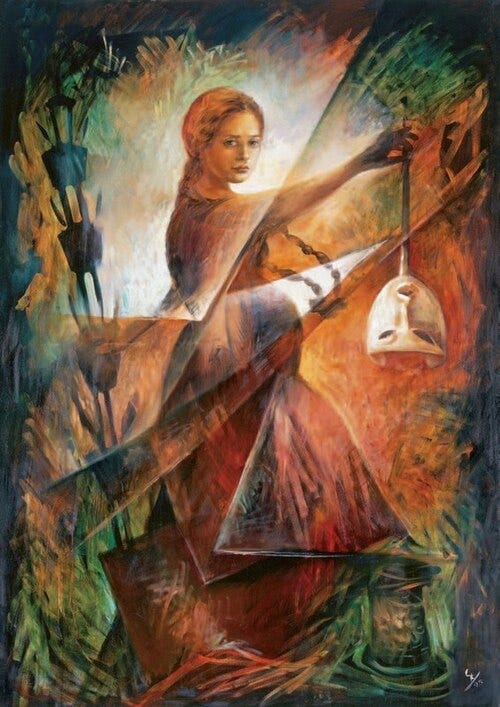

Tamar the Righteous One
Genesis 38 describes a Canaanite woman who was left in the dust by her father-in-law, Judah, after her first two husbands died. After Tamar’s first husband, Er, had passed, Er’s brother Onan was “honor-bound to marry [Tamar] and produce a male heir” for Er.3 Instead, the biblical text states he chose to spill his seed on the ground. He refused to procreate with Tamar because, according to the primogeniture system in the ancient Near East, his son would not actually be his (v. 9), but Er’s. If he did not produce a son for Er, the primogeniture system would have awarded Onan a greater inheritance since Er was out of the picture.4 Bummer for him that his immorality led to his death instead of Judah’s inheritance.
Once again, Tamar is left without a son by her first husband. Consequently, Judah pledges future betrothal to Tamar to his youngest son, Shelah, but sends Tamar off to her father’s house and does not follow through with his promise (v. 11). Levirate practices also designate the responsibility of the father-in-law to marry the widowed woman should his other sons not fulfill their responsibility.5 But instead, we are left with a selfish Judah: his sons did not fulfill their responsibilities, and he chose not to step up. Instead, he leaves Tamar in a difficult situation, completely inhibiting her from fulfilling her expected duties to produce an heir for Er. What was she to do? Sandra Glahn explains that,
“When Tamar hears about some of Judah’s travel plans, she puts on a veil and positions herself where she knows he will see her (v. 14). The text does not say she propositions him. In fact, it says Judah approaches her and asks, ‘How about it?’ (my paraphrase) (vv. 15–16). She secures three forms of ID from him and agrees (v. 18).”6 (emphasis added).
Knowing her context illuminates the reason why Judah claims, “She is more righteous than I, since I did not give her to my son Shelah” (v. 26). Tamar fulfills her duty to produce an heir, despite Judah completely missing the mark. But this translation does not capture what Judah is actually saying. In fact, Glahn continues her helpful explanation of the situation:
“While those are indeed his actual words, such a translation loses the sense. He is not saying, ‘I’m kind of righteous, and you outdid me on this one.’ His words mean, You’re the one in the right here, not me’ (v. 26). Scholars agree that this is not righteousness in degrees. Judah is wicked, Tamar is righteous.”
Tamar was considered righteous for continuing her husband’s line, and was later rewarded with something much greater: continuing the line that produced the Messiah himself (Matt 1:3). To our modern and ancient eyes alike, the identity of “prostitute” taints a person’s whole being. For Abraham’s descendants, “Canaanite” is equally stained.7 Yet to the biblical authors, Tamar’s actions earned her a different reputation. It is no surprise, then, that other biblical references to her are of blessing or honor. At Boaz and Ruth’s wedding, the elders bless him, “Through the offspring the Lord gives you by this young woman, may your family be like that of Perez, whom Tamar bore to Judah that his house would be like that of Tamar’s son Perez” (Ruth 4:12). David and Absalom name their daughters Tamar, likely after her.
Because of Tamar’s righteousness, Judah became a better man. Indeed, it is only after his encounter with Tamar that he reverts from the sins of his past.8 Having previously sold his brother into slavery (Gen 37:27) and abandoning his family to dwell in a Canaanite land (38:1), he travels with his brothers to Egypt amidst a horrible famine to inquire about food for their family (42:5). He not only acts on behalf of his brother, Benjamin, to his father (43:9), but on behalf of his family to Joseph (44:33-34). No longer a selfish man, he follows Tamar’s lead down the path of righteousness.
Tamar the ‘ezer kenegdo
By producing an heir for Er and being the wake-up call that Judah needed to pursue a righteous path, she embodies what it means to be the “helper” of Genesis 2:18. The text states that “The LORD God said, ‘It is not good for the man to be alone. I will make a helper suitable [‘ezer kenegdo] for him.” In many English translations, the Hebrew word, ‘ezer kenegdo, is often written as “helper” or “helper suitable” (shockingly, the KJV translates it as “help meet,” which is closer to the actual meaning.) However, our English translations do not capture the gravitas of the Hebrew. Hebrew scholar Robert Alter states that, “‘help’ is too weak because it suggests a merely auxiliary function, whereas ‘ezer elsewhere connotes active intervention on behalf of someone, especially in military contexts, as often in Psalms.”9 This kind of helper is not inferior to the man, but the kind that is “strong enough to render real assistance.”10 Furthermore, the Hebrew word kenegdo modifies ‘ezer and translates to “‘corresponding to him’ or ‘like him’… ‘suitable’ or ‘fitting.’”11 This assistance is not inferior—as is often understood—nor is it more powerful than the man. She comes alongside him. When describing ‘ezer kenegdo, Old Testament Carmen Joy Imes says that “God produced an ally corresponding to the man, who can share his tasks of cultivation and care of the garden.”12 Similarly, Alter suggests that ‘ezer kenegdo be translated to “sustainer beside him.”13 She is his equal, and he needs her.
Tamar exemplified this mighty help to Judah, reminding him of his obligation to provide for her and his own son. Even more, such actions spurred him to total repentance, resulting in reconciliation with his brother Joseph and, consequently, Joseph with the rest of his family. Carolyn Custis James argues that we need not only the story of Tamar—one that calls us to embody her “ezer-warrior courage and commitment”—but also the story of Judah, a reminder that redemption is possible, even in the darkest of moments.14
Unless we know Hebrew, the meaning of Tamar’s name, “date palm,” is lost on us. But now we can revisit her story to see how she embodies her name. Because God saw Tamar as righteous, she became a marriage blessing, a name for the daughters of future kings, and, most notably, a foremother in the Messiah’s genealogy. This very Messiah gives sweet redemption to his creation, both now and for eternity. Hear the gentleness in his words: “Come to me, all who are weary and heavy burdened, and I will give you rest” (Matthew 11:28). We can receive this rest and eat the fruit he gives, fruit that is sweet to our souls and nourishing to our bodies. And because God deemed Tamar righteous, we can rest under her branches—those that later bore the fruit of Christ.
Jacqueline Vayntrub, “Tamar and Her Botanical Image.” In Journal of Biblical Literature 139, no. 2 (2020): 301-318.
Carolyn Custis James, “Tamar: The Righteous Prostitute.” In Vindicating the Vixens: Revisiting Sexualized, Vilified, and Marginalized Women of the Bible, 31. Ed. by Sandra Glahn. Kregel Academic, 2017.
Custis James, “Tamar,” 38.
Custis James, “Tamar,” 39.
Custis James, “Tamar,” 43-44.
Custis James, “Tamar,” 35.
Custis James, “Tamar,” 47.
Robert Alter, "Genesis." In The Five Books of Moses, vol. 1 of The Hebrew Bible, 14. W. W. Norton & Company, 2018.
Lucy Peppiatt, “A Woman’s Natural Place: What the Creation Narrative tells us.” In Rediscovering Scripture’s Vision for Women: Fresh Perspectives on Disputed Texts, 50. IVP, 2019.
Carmen Joy Imes, “Crown of Creation.” In Being God’s Image: Why Creation Still Matters, 40. IVP, 2023. As referenced by Imes, see Joshua 1:14 and 1 Chronicles 12:1-22 for ‘ezer in military contexts, and 2 Chronicles 32:8, Psalm 10:14, Isaiah 41:10-14 for ‘ezer referring to God helping Israel.
Carmen Joy Imes, “Eve’s Legacy Is Both Sin and Redemption.” In Christianity Today, April 19, 2023. https://www.christianitytoday.com/ct/2023/mayjune/eve-legacy-sin-redemption-mother-genesis.html
Alter, Genesis,” 14.
Custis James, “Tamar,” 48.