On Anticipating Labor and Thoughts Thereafter
God will redeem more than nausea and contractions

I began writing this piece before I gave birth to my second daughter, and unsurprisingly, I didn’t finish it. Why? Because I was tired and pregnant. Yet rereading what I had already written while holding my sweet babe provided new insight: she is a foretaste of the restoration that God speaks of in Genesis 3.
The Waiting Period
Every woman who has ever been pregnant knows that the entire journey of growing a human being inside her body comes with mixed emotions. The last few weeks may be full of excitement, anxiety, despair, elation, or all of the above. If you’ve done it before, you know what to expect. But you also don’t know what to expect because every pregnancy, labor, and delivery is different.
Labor usually starts off slow, and you ease into it (again, usually). Mild contractions that are spaced out, and maybe you can sleep through them. But then active labor kicks in. Those contractions are powerful; an explosion of tightness that encompasses your entire abdomen, ebbing and flowing like waves crashing into a cliff. When it seems like it won’t end, you hit transition, and the intensity only increases. The baby is dropping, and it is time to push this whole human being out of your body after enduring hours of contractions (or maybe you have a C-section; both options are demanding in their own unique ways).
If you hike, think of traversing a 14er. There is a surge of adrenaline that rushes through you when you are at the bottom of the mountain and look upward. The excitement of summitting carries you each step––early labor into active––but you inevitably hit a wall––transition. Your feet ache, the elevation gain may cause dizziness or labored breathing, and you take frequent stops to fuel up. You say to yourself, “This is hard, but I can do hard things because I have to.” There is no going back.
But when you crest the mountain and take in the immensity of the range that surrounds you and inhale the fresh air, it is transcendent. When you wrap your arms around the sweet babe that you nourished for nine months, it is holy.
For me, anticipating a second labor and delivery was more daunting than exciting. I have friends who have said, “I had a pain-free, natural birth with no epidural!” and “I cannot wait to give birth again and see what I learn!” I did not relate to either of those sentiments. But a sweet prayer said from my husband eased my anxiety,
Lord, we thank you that even after the Fall, you didn’t take away the beauty of pregnancy, labor, and delivery. It is hard, painful work, but you still bless it and let it be beautiful.
A Problematic Interpretation of Genesis 3
In the face of the plentiful, unwarranted comments (often from women)—“Are you sure you’re ready? Are you sure you don’t want to get an epidural? Wow, you look like you’re ready to pop!”—It is easy to feel discouraged. Even more, there are theological interpretations of Genesis 3 that hyper-fixate on the pain of labor, which instills immense fear in women before going into labor. However, we often misunderstand what God says to Eve. There is a more faithful way to read this text.
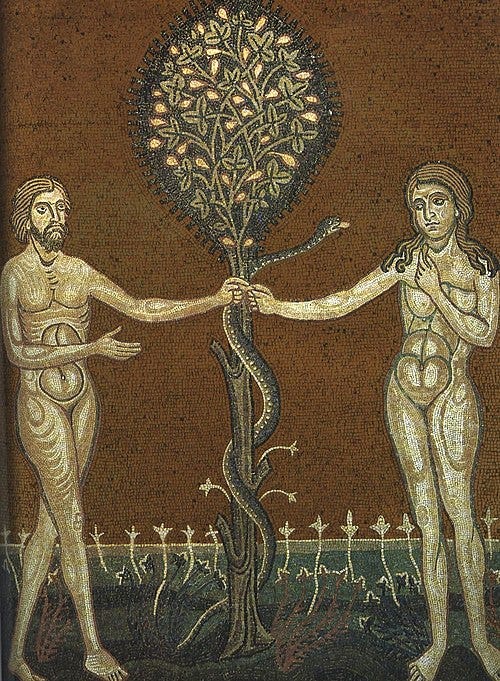
A typical summary (at least in my own experience) of the effects of sin on women in Genesis 3 is short and to the point: “Eve sinned, and women are now cursed with excruciating pain in having babies.” But the labor pain is only part of the story in Genesis 3, and we often misunderstand the repercussions of Adam and Eve’s sin.
The Lord God said to the serpent,
“Because you have done this, cursed are you among all animals and among all wild creatures; upon your belly you shall go, and dust you shall eat all the days of your life. I will put enmity between you and the woman and between your offspring and hers; he will strike your head, and you will strike his heel.”
To the woman, he said,
“I will make your pangs in childbirth exceedingly great; in pain you shall bring forth children, yet your desire shall be for your husband, and he shall rule over you.”[1]
And to the man he said,
“Because you have listened to the voice of your wife and have eaten of the tree about which I commanded you, ‘You shall not eat of it,’ cursed is the ground because of you; in toil you shall eat of it all the days of your life; thorns and thistles it shall bring forth for you; and you shall eat the plants of the field. By the sweat of your face you shall eat bread until you return to the ground, for out of it you were taken; you are dust, and to dust you shall return.” (Gen. 3:14-19, emphasis added)
God curses the serpent and the ground, not humanity. Instead, humans experience the effects of these curses: sin will taint every aspect of life on earth, leading to death for every creature, including them. John Walton calls this “parental correction.” The humans chose a way different than God’s, so now God lets them experience the consequences, and “not all consequences are punishments.”[2]
In the beginning, God blessed humans with the calling to be fruitful and multiply and to have dominion over the earth. Instead of pursuing this calling and walking with God in the garden, they made themselves gods and disobeyed their Creator. When we incorrectly say God cursed humanity, it distorts the reality of both sin and God’s intention for us.
Though there are consequences for their actions, God still intends to bless his image bearers despite their disobedience; sin is not powerful enough to take away this blessing. He drives them out of the garden so that they do not eat from the tree of life and live forever in their bondage to sin (v. 22-24) and promises that Eve’s offspring will come to crush the serpent (v. 15). This is the strike that will release them from their bondage.
The specific bondage that Genesis 3 provides is “pain in childbearing,” but this cannot be summed up merely as bad labor pains. When this is the case, we miss the long-term effects of pain both before pregnancy and after birth. Carmen Joy Imes argues that “the woman’s relationship with creation is marked by hostility. Her ability to follow her calling to fill and subdue the earth is marked by pain—distress in conception and pain in childbirth” (emphasis added).[3]
John Walton explains what this distress includes. The word for “childbearing” in Hebrew is actually conception. Since there is no pain in conception itself, he argues that the word for pain (in conception) has more to do with anxiety. Physical pain, of course, causes anxiety, but in the ancient world, conception was a greater issue of anxiety. It prompts many questions: “Will the baby survive pregnancy or childbirth? Will I? What if I can’t get pregnant––will my family disown me?” There is now an increase in anxiety from conception to childbirth; there are labor pains and anxiety that surround the entire process.[4]
Though Walton concludes that the text does not expand beyond conception, pregnancy, and labor, Carrie Miles argues that it does and provides a helpful example of the hostility that surrounds “the woman’s relationship with the earth,” as Imes argues. God originally blessed humans to subdue the earth, cultivating life both on the land and through childbearing. Now, “Sexuality would become utilitarian, reproductivity in service of productivity, and put to hard work. For after the Fall, what Adam needed from his wife was not their mutual pleasure and companionship but the tool her difference made from him gave in him his struggle against the hostile world—her ability to bear children.”[5] Why? Because in an unindustrialized culture, children were needed for production. Not just for profit, but survival. Children were more loyal than servants, both in producing the necessary goods for survival and in being more likely to stick around and take care of their aging parents.
In Iain Provan’s study of Genesis 3:16, he also argues that there is an economic element to the toiling that Adam and Eve must do. The fate of the man—in pain, eating from the cursed ground—matches that of the woman. “He knows [toil], as she does; and in this case [toil] certainly refers to challenging (painful) economic circumstances, as the man is locked in a struggle with the land, hoping through “painful toil” to grow sufficient “green plants” … in the midst of “thorns and thistles” to survive.[6]
Now, it must be noted that people did not have children simply to use them. Scripture has many stories of parents enjoying their children simply because they were theirs. However, children were no longer seen solely as part of God’s blessing to Adam and Eve—a gift to be loved and cherished and to help be fruitful and multiply—but also as necessary agents in ensuring humanity’s survival (there is a reason that we have child labor laws.) Miles continues, “Thus, after the fall, Eve is mentioned again only in the role of mother, giving birth to Cain, Abel … and Seth. Adam was no longer a leisurely keeper of a garden but a subsistence farmer eating his bread by the sweat of his brow, and he needed children to help in the endless struggle with the ground.”[7]
There is pain and anxiety in conception, labor, and delivery, and parenthood altogether. But this is not a curse from God. Rather, since the woman chose her own path in direct defiance of God’s command, she will now experience great pain and anxiety as consequences when she brings forth children. However, God will bring forth one who will redeem her from it all.
On the Other Side of Birth
After a discouraging induction due to having epilepsy, my 32-hour labor taught me many things. The night of the induction, I slept through mild contractions and remembered Romans 8: The Spirit groans for us on our behalf. The following morning, I shared this with my husband and dear friend, Steph, who came to support me. She, too, prayed through Romans 8 for me that very night (it is almost as if the Holy Spirit was speaking to me.) She read it to us that morning, and returning to this section now, I am reminded of the redemption that God promises Adam and Eve in Genesis 3.
I consider that the sufferings of this present time are not worth comparing with the glory about to be revealed to us. For the creation waits with eager longing for the revealing of the children of God, for the creation was subjected to futility, not of its own will, but by the will of the one who subjected it, in hope that the creation itself will be set free from its enslavement to decay and will obtain the freedom of the glory of the children of God. We know that the whole creation has been groaning together as it suffers together the pains of labor, and not only the creation, but we ourselves, who have the first fruits of the Spirit, groan inwardly while we wait for adoption, the redemption of our bodies. For in hope we were saved. Now hope that seen is not hope, for who hopes for what one already sees? But if we hope for what we do not see, we wait for it with patience.
Likewise, the Spirit helps us in our weakness, for we do not know how to pray as we ought, but that very Spirit intercedes with groanings too deep for words. And God, who searches hearts, knows what is the mind of the Spirit, because the Spirit intercedes for the saints according to the will of God. (Rom 8:18-27)
That the Spirit intercedes on our behalf remains a mystery to me. But this much is clear: The Holy Spirit—God Himself—intimately knows our suffering and promises to redeem our very bodies.
The painful contractions, yes. But also all that comes with the anxieties of conception and life thereafter: infertility, miscarriages, and stillbirths; raising children in a terrifying world in which you cannot protect them; watching them suffer and maybe losing them to death.
The Messiah came and, by his resurrection, has already crushed the serpent. As we wait, we can hold new life in our arms and anticipate the redemption of all creation, clinging to hope as the Spirit intercedes on our behalf.
[1] Addressing the second half of this verse, “yet your desire shall be for your husband, and he shall rule over you,” is beyond the scope of this piece. To learn more about this verse, listen to this podcast interview with John Walton.
To read more about this verse and a counterargument to the notion that God created Adam first, thereby giving him authority over Eve, see this article by Bobby Gilles.
[2] See “Exegetically Speaking” interview with John Walton here.
[3] Carmen Joy Imes, Being God’s Image: Why Creation Still Matters. (IVP Academic, 2023), 54.
[4] Walton Interview.
[5] Carrie A. Miles, The Redemption of Love: Rescuing Marriage and Sexuality from the Economics of a Fallen World. (Brazos Press, 2006), 36.
[6] Iain Provan, “Pain in Childbirth? Further Thoughts on an Attractive Fragment (1 Chronicles 4:9-10), in Let us Go up to Zion, ed. Iain Provan and Mark J. Boda (Brill, 2012), 290.
[7] Miles, 37.
That Miles book is so good!
Really enjoyed this. Just watched Hamnet the other night, pretty vivid labor scenes in that film--Jessie Buckley is a revelation.
Unrelated to Hamnet, I've recently been wondering about new life and new creation, presumably reproduction is not a part of new heaven/new earth and that kinda makes me sad? I'd be curious to explore an eschatology of children/birth etc.